

Featured on:

Time in UAE: Tue, 14 Jul 26 05:40
UAE visa-on-arrival for Kenyans with residence permits, e-visa guide for Ghanaians, work visa steps, fees, and common rejection reasons. Updated July 2026.
On June 25, 2026, the UAE quietly expanded visa-on-arrival access for Kenyans. The catch? It only applies if you hold a residence permit from a specific list of countries, not a visitor visa. That single detail is turning travelers away at the airport.
Key Takeaways:
The check-in agent at JKIA held up my friend’s passport, pointed to the US B1/B2 visa, and said, “This is not a residence permit.” That’s when we stopped assuming any US visa would work and started checking the exact residence permit list every time. This guide gives you the exact eligibility, step-by-step e-visa instructions for Ghanaians, and the work visa realities no one talks about. Now, let’s break down exactly what changed and what didn’t.
Before you book your flight, know which rules apply to your passport.
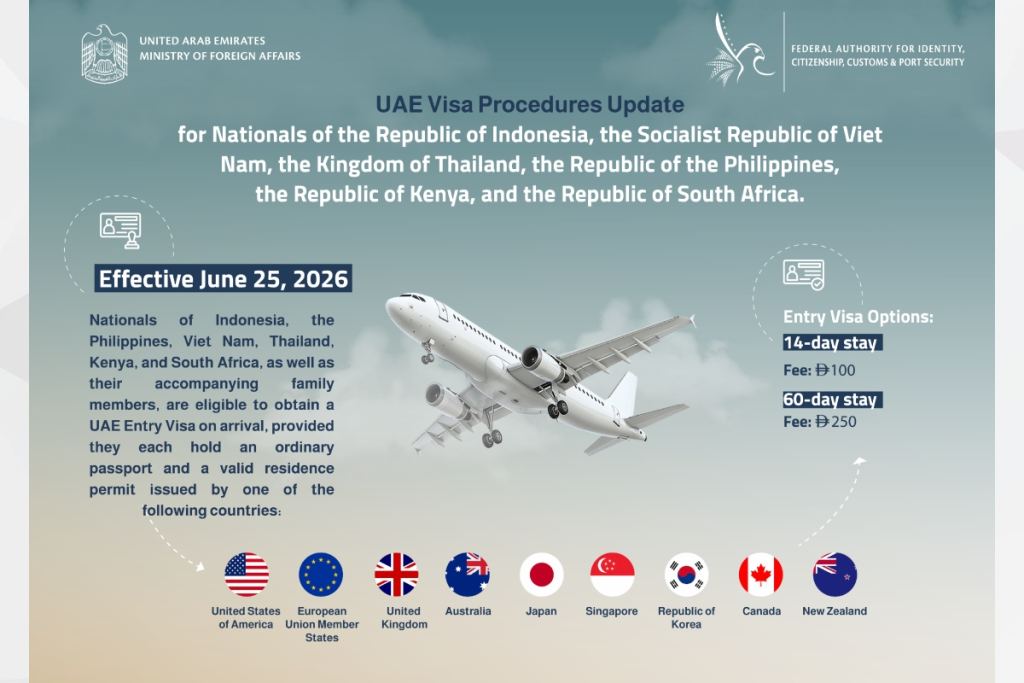
On June 25, 2026, the UAE Ministry of Foreign Affairs (MOFA) announced visa-on-arrival for Kenyan ordinary passport holders, but only if they hold a valid residence permit from the US, UK, EU, Australia, Canada, New Zealand, Japan, Singapore, or South Korea. Family members traveling with the eligible Kenyan also qualify. The policy grants either a 14-day or 60-day stay, not the previously assumed 30-day single entry.
The word “visa-free” in a headline is a trap. We’ve had Kenyan travelers arrive at the check-in counter waving a news article that said “UAE visa on arrival for Kenyans,” only to be denied because they held a US visitor visa, not a residence permit.
The policy is clear: it’s a residence permit from one of nine countries, not any visa. But the headlines rarely make that distinction. That’s the unglamorous truth: a design choice that sounds generous on paper becomes a daily headache at the airport. Confusion is widespread because many outlets omitted the residence permit condition.
This guide relies on the official MOFA statement and cross-verified reporting.
Ghanaians remain entirely outside this policy. No change. Their only legal route is an e-visa obtained before travel, regardless of any other visas or permits they hold.
Important Consideration: This section is based on the official MOFA press release dated June 25, 2026, cross-verified with reporting by The Star (June 26, 2026).
Expert Tip: Even if you qualify for visa on arrival, always check the latest entry requirements on the ICP or GDRFA website 48 hours before your flight; rules can change with little notice.
Next, we’ll walk through the exact eligibility checklist for Kenyan passport holders.
If you hold a Kenyan passport, the answer to “Can I get a visa on arrival?” depends on one thing: your residency status.
The June 25, 2026 MOFA announcement is clear. You qualify if you hold an ordinary Kenyan passport and a valid residence permit from the US, UK, EU, Australia, Canada, New Zealand, Japan, Singapore, or South Korea. That list expanded in June 2026 to include New Zealand, Japan, Singapore, and South Korea: a detail many travelers miss.
At the airport, you need three things: your Kenyan passport, the qualifying residence permit, and a printed copy of the MOFA announcement. Will the check-in agent actually know about the new rule?
At VisaTop, we recently helped a Kenyan traveler with a US Green Card visit Dubai. We also advised him to carry a copy of the June 2026 MOFA announcement along with his passport to avoid unnecessary questions at check-in.
At the counter, the agent hesitated, then read the document and nodded. That piece of paper saved him a denied boarding.
Immediate family members traveling with you also get the visa on arrival: no separate application needed.
Expert Tip: Print the June 2026 MOFA announcement and carry it with your residence permit. Airline check-in staff often rely on outdated Timatic rules and may deny boarding without official proof.
The visa on arrival grants either a 14-day or a 60-day stay. It is not the previously assumed 30 days. Confirm the exact duration when the immigration officer stamps your passport.
No qualifying residence permit? You must apply for an e-visa before you travel. The process mirrors the Ghanaian e-visa path detailed in the next section: same document list, same ICP portal, same fees. Skip ahead to that walkthrough for the full step-by-step.
Differentiation Opportunity: This VisaTop guide clearly separates the two Kenyan travel pathways with practical, step-by-step checklists, helping travelers avoid the common mistake of assuming all Kenyan passport holders qualify for a Dubai visa on arrival.
For Ghanaian passport holders, the path is different: there is no visa-on-arrival option, period.
If you hold a Ghanaian passport, there is no shortcut. Every applicant must secure an e-visa before departure. No visa-on-arrival option exists for Ghanaians, and the only legal route is the official ICP portal. Embassies do not issue tourist visas; airlines, hotels, and travel agents are intermediaries that still route through ICP, often with added fees.
Gather these exact documents before opening the portal. A single missing item or mismatch will bounce your application.
The top cause of rejection is a name mismatch. Enter your name exactly as it appears in the machine-readable zone of your passport: middle name included, no abbreviations. Even a missing hyphen can trigger a refusal.
Expert Tip: Use a USD-denominated Visa or Mastercard from a Ghanaian bank (e.g., GTBank, Access Bank) to avoid payment failures; enable international transactions and 3D Secure beforehand.
The third decline, a GTBank USD Visa card in incognito mode, finally pushed the payment through. The ICP payment gateway is notoriously sensitive to 3D Secure authentication. If your card is declined, switch to a different browser in incognito mode, clear your cache, and try a card you know has 3D Secure active. A USD-denominated card avoids dynamic currency conversion fees that can trigger fraud blocks.
Service Recommendation: You can apply through the official ICP Smart Services Portal (icp.gov.ae), but if you’d rather avoid paperwork, document errors, and delays, VisaTop can handle the entire application process for you. Our team reviews your documents, submits your application correctly, and keeps you updated until your Dubai visa is approved.
Now let’s compare every tourist visa type side by side so you can pick the right one.
Choosing the wrong visa type can cost you hundreds of dollars in extension fees: here’s how to get it right the first time.
Kenyan passport holders eligible for visa on arrival get either 14 or 60 days, not 30. Check your residence permit validity. For everyone else, the e-visa system offers four clear choices.
A 30-day single-entry visa suits a quick holiday, but if you plan to stay beyond two weeks, the 60-day single-entry visa is the smarter financial move. In-country extensions can easily exceed $200, while the 60-day visa costs only about $50 more than the 30-day upfront. Multiple-entry visas are ideal for frequent travelers who cross in and out of the UAE, but they come at a steep premium.
| Visa Type | Duration | Entry | Fee (USD) | Fee (KES) | Fee (GHS) | Processing Time | Best For |
|---|---|---|---|---|---|---|---|
| 14-Day Tourist Visa | 14 days | Single | ~$140 | ~KSh 18,200 | ~GH₵ 1,750 | 3–5 working days | Short business or leisure trips |
| 30-Day Tourist Visa | 30 days | Single | ~$160 | ~KSh 20,800 | ~GH₵ 2,000 | 3–5 working days | Standard leisure trips |
| 60-Day Tourist Visa | 60 days | Single | ~$270 | ~KSh 35,100 | ~GH₵ 3,375 | 3–5 working days | Extended stays without extension hassle |
| 30-Day Multiple Entry | 30 days per visit | Multiple | ~$230 | ~KSh 29,900 | ~GH₵ 2,875 | 3–5 working days | Frequent short trips |
| 60-Day Multiple Entry | 60 days per visit | Multiple | ~$310 | ~KSh 40,300 | ~GH₵ 3,875 | 3–5 working days | Frequent long stays |
| Visa on Arrival (Kenya only, eligible) | 14 or 60 days* | Single | Free | Free | Free | On arrival | Eligible Kenyans with qualifying residence permits |
*The duration depends on your residence permit validity; it is never 30 days. The June 2026 expansion added New Zealand, Japan, Singapore, and South Korea to the qualifying permit list.
Expert Tip: The 60-day single-entry visa is often cheaper than a 30-day visa plus in-country extension fees, which can exceed $270.
Many travelers assume the 30-day visa is the cheapest option, but that’s not always true. At VisaTop, a 30-day single-entry visa costs $160, while a 60-day single-entry visa costs $270. If you know you’ll stay longer than 30 days, choosing the 60-day visa from the start is often the smarter option. Extending a 30-day visa later adds extra fees and paperwork, making it more expensive than simply applying for the correct visa upfront. VisaTop recommends selecting the visa that matches your full travel plans to save both time and money.
All tourist e-visas require the same core documents: passport scan, photo, flight itinerary, hotel booking, bank statement, and for Ghanaians, a yellow fever certificate. Processing times average 3–5 working days, so apply at least a week before travel.
Ready to apply? The next section walks you through the e-visa portal screen by screen.
The ICP portal can feel intimidating. Follow these steps exactly, and you’ll get through without a rejection.
Before you even open the portal, gather: passport valid 6+ months, confirmed flight itinerary, hotel booking, 3-month bank statement, yellow fever certificate, and a compliant digital photo. Missing any of these will stall your application.
The photo is the top rejection reason. The photo must meet the UAE’s standard passport-size dimensions (check the ICP portal for exact measurements). Use a professional service or a passport photo app that outputs the exact dimensions.
On the ICP portal, select ‘Issue Tourist Visa’. Fill personal details exactly as in your passport: name order is critical. A single mismatch between your passport and the form will get you rejected. Double-check every field before moving to documents.
Payment is where many applicants hit a wall. The portal requires a credit card with 3D Secure enabled. If your payment fails, clear your browser cache or switch to a different card.
During the June 2026 visa-on-arrival rollout, VisaTop assisted several Kenyan travelers who experienced payment issues while applying online. In many cases, the problem wasn’t the portal—it was a bank card that didn’t support 3D Secure authentication. Switching to a compatible Visa or Mastercard usually resolved the payment immediately. If you run into payment errors, VisaTop can help identify the issue and guide you through a successful application without unnecessary delays.
Unique Tip: A real-life application timeline follows a Ghanaian applicant from submission to approval, highlighting the process, documents, and a payment fix. In early July 2026, a Ghanaian applicant submitted with all required documents; payment failed due to a non-3D Secure card. After switching to a Visa card with 3D Secure, the application was approved three days later.
After payment, you’ll get a reference number. Use it to track your application on the ICP portal. Approvals typically take 2–5 working days.
Consideration That Must Be Given: If you’re applying through VisaTop, simply follow the instructions provided by our team. If you choose to apply directly through the official ICP portal, note that the application steps are based on the portal interface as of July 2026 and may change over time.
Beyond tourism: if you’re looking to work in Dubai, the next section covers the work visa path in detail.
Most guides stop at tourism, but if you’re reading this, you’re probably thinking bigger.
Differentiation Opportunity: Unlike most guides that stop at tourism, this section provides the only comprehensive work visa roadmap for Kenyans and Ghanaians.
There’s also a mid-tier long-term residency option worth knowing about, covered in our Silver Visa UAE guide, for those who don’t meet Golden Visa thresholds but still want multi-year stability.
If you’re coming to the UAE to study rather than work, the requirements differ significantly; see our dedicated UAE student visa guide for admission and sponsorship rules.
And if you’re past your working years and considering the UAE for retirement instead, our UAE retirement visa guide walks through the age, income, and property requirements.
Use Bayt, LinkedIn, GulfTalent. Never pay agents for job offers.
Change status in-country if eligible; otherwise, do a visa run. Budget for unexpected costs. Once your work visa is approved, bringing your spouse and children over follows the same family visa process outlined earlier.
Expert Tip: Start certificate attestation early: your degree must be stamped by your home country’s Ministry of Education, Ministry of Foreign Affairs, and the UAE Embassy, a process that can take weeks. We lost three weeks and AED 800 getting a degree stamped by three ministries before the UAE Embassy would even look at it.
Visa Tracking Recommendation: Verify your employer’s license and work permit status on the MOHRE website, and track visa stamping via the GDRFA Dubai portal.
This guide references official MOHRE work permit guidelines and UAE Labour Law; always confirm current procedures with your employer’s PRO, as policies can change.
Before you submit anything, use this master checklist to make sure every document is perfect.
A single missing document can reset your timeline by weeks: use these checklists to get it right the first time.
| Document | Specification | Notes |
|---|---|---|
| Passport | Valid for at least 6 months from date of entry; minimum 2 blank pages | Applies to both e-visa and visa-on-arrival applicants |
| Photograph | Recent passport-size, white background, approximately 4.3 cm x 5.5 cm | Digital copy for e-visa; physical copy for visa-on-arrival |
| Flight Itinerary | Confirmed round-trip or onward ticket | Must show entry and exit from the UAE |
| Accommodation Proof | Hotel booking confirmation or host’s residence proof | Kenyans using visa-on-arrival must present a confirmed hotel booking |
| Bank Statement | Last 3–6 months, showing consistent monthly income; minimum balance equivalent to around AED 3,000 | A steady salary history carries more weight than a one-time lump sum |
| Travel Insurance | Mandatory; minimum medical coverage of around AED 150,000, including COVID-19 | Many applicants overlook the coverage amount and get rejected |
| Yellow Fever Certificate | Valid International Certificate of Vaccination | Mandatory for Ghanaian citizens; missing it is the most common cause of rejection |
The yellow fever certificate is the single document that sinks more Ghanaian applications than any other. A client last month had a flawless bank statement, a confirmed hotel on Sheikh Zayed Road, and a return ticket, but no yellow fever card. The rejection came in 48 hours. We’ve seen it happen year after year; it’s the one item you can’t fix after submission.
Expert Tip: If your bank statement shows a sudden large deposit, attach a brief explanation (e.g., salary bonus, gift) to avoid suspicion of borrowed funds.
Now let’s talk money: exactly what you’ll pay and how to make sure your payment goes through.
Processing and payment methods
VisaTop tourist visa applications are typically processed within 3–5 working days. If you need your visa urgently, express processing is available for an additional fee, with approvals often completed within 24–48 hours.
For UAE work visas, processing takes longer because it involves several government approvals. The MOHRE work permit generally takes 2–5 working days, followed by the entry permit in another 2–3 working days. After arriving in the UAE, you’ll complete a medical examination, apply for your Emirates ID, and finish the residence visa process. From job offer to a stamped residence visa, allow around 2–3 weeks.
One of the most common issues VisaTop sees isn’t missing documents but payment failures. Many applicants complete the entire application successfully, only to have their bank card declined during payment. In many cases, this happens because the card doesn’t support the required international online authentication or the bank blocks the transaction.
Before applying, VisaTop recommends contacting your bank to inform them you’ll be making an international online payment in AED. If available, use a Visa or Mastercard linked to a USD account, as these often process international transactions more smoothly.
If you’re applying through VisaTop, you don’t have to worry about payment gateway issues or application errors. Our team handles the entire application process, verifies your documents, submits your application correctly, and keeps you updated until your visa is approved.
Service Recommendation: Apply through VisaTop to avoid payment failures, document mistakes, and unnecessary delays. Our visa specialists manage the process from start to finish, giving you a smoother and more reliable application experience.
Even with perfect documents, small mistakes can still lead to visa rejection. Here are the 10 most common mistakes and how to avoid them.
Rejections are expensive and stressful, but almost all of them are preventable if you know what to watch for.
When a visa is refused, the ICP or GDRFA system almost always attaches a short rejection reason code, plain‑language labels like “Insufficient Funds,” “Unclear Passport Copy,” or “Photo Does Not Meet Specifications.” These aren’t generic; they pinpoint the exact document or data field that failed. A single blurry passport scan cost me 14 days and $100 in reapplication fees, but the rejection code “Unclear Passport Copy” told me exactly what to fix.
Read the code literally. If it says “Insufficient Funds,” don’t guess: upload a statement with a higher balance. If it says “Mismatched Name,” check every character against your passport.
Expert Tip: If your visa is rejected, you’ll usually receive a reason code, such as “Insufficient Funds” or “Unclear Passport Copy,” address the specific issue and reapply; there’s no mandatory waiting period, but fix the root cause first.
Correct only what the rejection code flagged. Gather fresh, clean versions of the problematic documents: a new scan, an updated statement, a properly formatted photo. Log back into the ICP portal, start a new application, and upload everything again through our visa processing service if you’d rather not manage it solo. Do not reuse the old draft; a fresh submission avoids carrying over hidden errors. Most applicants who fix the single stated issue get approved on the next attempt.
Agents who aren’t registered with ICP or GDRFA often cut corners: they reuse old photos, invent hotel bookings, or submit applications under the wrong nationality category. The rejection lands on your passport number, not theirs, and can even shade into the fraud scenarios described in our Dubai visa fraud and fines guide. Always confirm you’re on the official portal (smartservices.icp.gov.ae) or the GDRFA site. If someone else is filling the form, watch them do it and review every field before payment.
Still have questions? The FAQs cover the scenarios our readers ask about most.
These are the questions our readers ask most: straight answers, no runaround.
Can Kenyans get a visa on arrival in Dubai?
Yes, if they hold a valid residence permit from the US, UK, EU, Australia, Canada, New Zealand, Japan, Singapore, or South Korea. Family members traveling with them also qualify.
Do Ghanaians qualify for visa on arrival?
No. Ghanaians must obtain an e-visa before travel.
Can I work on a tourist visa?
No. Employment requires employer sponsorship through MOHRE, or self-sponsorship via a freelance visa.
Can my family travel with me on a visa on arrival?
For eligible Kenyans, yes: family members traveling with the primary holder qualify, similar to how a family visa works for dependents joining a primary applicant already in the UAE.
How long can I stay on the visa on arrival?
The visa grants either a 14-day or 60-day stay, not the previously assumed 30 days. If you need more time once you’re there, check our guide on extending a visit visa in Dubai.
Before you head to the airport, run through this final checklist.
You’ve got the visa: now make sure you have everything you need at the airport.
The only checklist that matters is the one you check 24 hours before your flight. A client once landed in Dubai with a printed e-visa that had been approved three weeks earlier, only to discover at immigration that a quiet policy update had invalidated it overnight. The fix was simple: a fresh check on the ICP portal or a quick passport-number status check would have flagged the change and let her reapply before leaving Nairobi.
That single habit, verifying the official source right before departure, has saved every traveler I’ve worked with since. The MOFA announcement on June 25, 2026, is a perfect example: it opened a door for Kenyans with specific residence permits, but only those who confirmed the details on the portal walked through without a hitch.
Visa rules can change without notice. Always verify the latest requirements on the official UAE government portals before you travel. This guide was last updated on July 6, 2026.
Before you head to the airport, run through this list:
